
today’s digital world, businesses are constantly competing for customers’ attention. From social media posts and search engine advertisements to email campaigns and websites, companies use many digital channels to reach their target audience. But simply running digital marketing campaigns is not enough. Businesses also need to understand whether those campaigns are actually working.
This is where Digital Marketing Analytics becomes important.
Digital marketing analytics refers to the practice of gathering, tracking, evaluating, and understanding data generated through various online marketing activities. It helps businesses identify what is working, understand customer behavior, and make informed decisions to improve their digital marketing performance.. It helps businesses understand customer behavior, measure campaign performance, identify opportunities, and make better marketing decisions.
Instead of relying on assumptions, marketers can use data to answer important questions such as: Which campaign generated the most customers? Marketers can use analytics to determine which social media channels generate the most engagement and conversions. They can also track how many website visitors take meaningful actions, such as making a purchase, submitting a form, or signing up for a service.How much money is being spent to acquire each customer?
What Is Digital Marketing Analytics?
Digital marketing analytics involves using data and analytical tools to evaluate the performance of online marketing activities. Data can come from websites, search engines, social media platforms, email campaigns, online advertisements, mobile applications, and e-commerce platforms.
For example, suppose an online clothing store runs advertisements on Instagram and Google. After a month, the company can analyze how many people clicked each advertisement, how many visited the website, how many purchased products, and how much revenue was generated.
This information allows marketers to compare the two campaigns and determine where their marketing budget should be invested.
Digital marketing analytics therefore turns large amounts of customer and campaign data into useful insights.
Why Is Digital Marketing Analytics Important?
One of the biggest advantages of digital marketing is that many activities can be measured. Traditional marketing methods such as newspapers, billboards, and television advertisements can be difficult to measure precisely. Digital platforms, on the other hand, provide detailed information about user interactions.
1. Better Decision-Making
Analytics allows marketers to make decisions based on real data rather than assumptions. If a particular campaign is producing excellent results, the business can invest more in it. If another campaign is underperforming, marketers can change or stop it.
2. Understanding Customer Behavior
Analytics helps businesses understand what customers want and how they behave online. Marketers can discover which pages customers visit, what products they view, what content they engage with, and where they leave the website.
Understanding this behavior helps businesses create more relevant marketing strategies.
3. Measuring Return on Investment
Marketing requires investment. Businesses need to know whether the money they spend on advertising is generating sufficient returns.
Analytics can help calculate metrics such as Return on Investment (ROI) and Return on Ad Spend (ROAS). These measurements help marketers determine whether their campaigns are financially successful.
4. Improving Customer Experience
Data can reveal problems in the customer journey. For example, if many users visit a product page but leave before completing a purchase, the business can investigate why.
Perhaps the checkout process is complicated, the website is slow, or customers are not finding enough product information. Analytics can help identify these issues.
Key Digital Marketing Analytics Metrics
There are many metrics marketers can track. However, the most useful metrics depend on the business objectives.
Website Traffic
Website traffic indicates the volume of people who visit and interact with a website over a specific period of time. Marketers can analyze where visitors come from, such as search engines, social media, advertisements, direct visits, or referral websites.
A growing amount of relevant traffic can indicate that marketing activities are attracting more potential customers.
Conversion Rate
A conversion happens when a visitor takes a desired action.This could be purchasing a product, submitting a form, signing up for a newsletter, downloading an application, or requesting information.
The conversion rate shows the percentage of visitors who complete that desired action.
For example, if 1,000 people visit an online store and 50 make a purchase, the conversion rate is 5%.
Click-Through Rate
Click-through rate, commonly called CTR, measures how many people click on an advertisement, email link, or search result after seeing it.
A higher CTR can indicate that the message or advertisement is relevant and attractive to the target audience.
Bounce Rate
Bounce rate helps marketers understand how often visitors leave a website after viewing a page without taking another action.
A high bounce rate does not necessarily indicate that a page is performing poorly. For example, someone may visit a blog article, find the information they need, and leave. Therefore, marketers should interpret bounce rate alongside other metrics.
Cost Per Acquisition
Cost Per Acquisition (CPA) measures how much it costs a business to acquire a customer or complete a desired conversion.
If a company spends $1,000 on advertising and gains 50 customers, the CPA is $20 per customer.
This metric is especially useful when comparing different marketing campaigns.
Customer Lifetime Value
Customer Lifetime Value (CLV) estimates the total value a customer may generate for a business throughout their relationship with the company.
CLV helps businesses understand that acquiring a customer is not only about making one sale. A loyal customer may make repeated purchases over several years.
Tools Used in Digital Marketing Analytics
Marketers use a variety of tools to collect and analyze digital marketing data.
Google Analytics is one of the most widely used tools for analyzing website and app activity. It can provide information about users, traffic sources, engagement, conversions, and other aspects of digital performance.
Search marketing platforms also provide valuable information. For example, search performance tools can help marketers understand how people discover websites through search engines.
Social media platforms such as Instagram, Facebook, LinkedIn, and YouTube provide analytics dashboards that show information about reach, engagement, audience characteristics, and content performance.
Advertising platforms such as Google Ads and Meta Ads also provide campaign-level information, including impressions, clicks, conversions, and advertising costs.
Customer relationship management systems can further connect marketing data with leads, sales, and customer information.
The most effective marketers do not simply collect data from these tools. They combine relevant information to develop a complete understanding of marketing performance.
The Role of Data in SEO
Digital marketing analytics plays an important role in Search Engine Optimization (SEO).
SEO involves improving a website so that it can gain better visibility in search engine results. Analytics helps marketers determine which search terms bring visitors to a website, which pages attract organic traffic, and which content performs well.
For example, if a business discovers that an article about “digital marketing strategies” is attracting thousands of visitors, it may create additional content around related topics.
Analytics can also identify pages that receive traffic but generate few conversions. Marketers can then improve those pages by adding clearer calls to action, better information, or more relevant offers.
Social Media Analytics
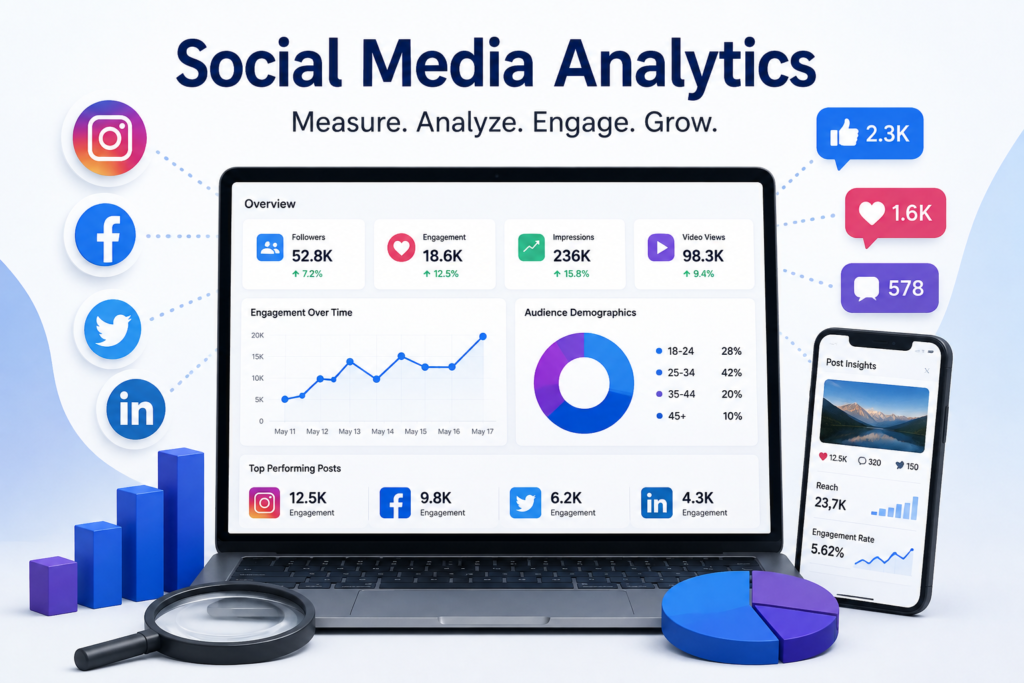
Social media marketing produces enormous amounts of data. Businesses can use analytics to determine which content their audiences prefer.
Metrics such as likes, comments, shares, saves, video views, follower growth, and engagement rates can provide valuable insights.
However, marketers should not focus only on likes and followers. A social media account with fewer followers can sometimes generate more sales than a larger account if its audience is highly relevant.
For this reason, businesses should connect social media metrics with actual business objectives such as website visits, leads, conversions, and revenue.
Using Analytics to Improve Content Marketing
Content marketing focuses on creating relevant and valuable content to attract and engage an audience. This can include blog posts, videos, podcasts, guides, case studies, and social media content.
Analytics helps marketers determine which content performs best.
For example, a company may publish ten blog posts and discover that three of them generate most of the website traffic and leads. The company can study those successful topics and create more content based on similar customer interests.
Analytics can therefore make content marketing more strategic and less dependent on guesswork.
Challenges of Digital Marketing Analytics
Although analytics provides many benefits, it also has challenges.
One major challenge is data overload. Businesses can collect thousands of data points, but not all of them are useful. Marketers need to identify the metrics that directly support business objectives.
Another challenge is data quality. Incorrect tracking configurations or incomplete data can lead to misleading conclusions.
Privacy is also increasingly important. Businesses must handle customer information responsibly and follow applicable privacy and data-protection requirements.
Finally, marketers need analytical skills. Collecting data is relatively easy, but interpreting it correctly requires knowledge, experience, and critical thinking.
The Future of Digital Marketing Analytics
The future of digital marketing analytics is closely connected to artificial intelligence and machine learning. These technologies can analyze large amounts of information and identify patterns that may be difficult for humans to detect manually.
AI can help marketers forecast customer behavior, personalize content, identify potential customers, optimize advertising campaigns, and automate certain reporting tasks.
At the same time, human judgment will remain important. Data can show what happened, but marketers still need to understand why it happened and decide what action to take.
The future will therefore involve a combination of advanced technology and human creativity.
Conclusion
Digital marketing analytics has become an essential part of modern marketing. It enables businesses to understand their audiences, measure campaign performance, improve customer experiences, and use marketing budgets more effectively.
From website traffic and conversion rates to customer lifetime value and return on advertising spend, analytics provides marketers with valuable information for making informed decisions.
However, successful digital marketing analytics is not about collecting as much data as possible. It is about collecting the right data, interpreting it correctly, and turning insights into action.
As digital channels continue to evolve, businesses that effectively use analytics will have a stronger ability to understand their customers, adapt to changing market conditions, and achieve sustainable growth.
In a competitive digital marketplace, data is more than just numbers. When analyzed and used effectively, data becomes a powerful tool for making smarter marketing decisions.